
We are reader supported. When you purchase through links on our site, we may earn an affiliate commission. Also, as an Amazon affiliate, we earn from qualifying purchases.
Corydoras fry are tiny, constant grazers with small mouths and a fast metabolism. The right first foods determine survival, growth rate, and body shape. This guide shows exactly what to feed from day one through the first month, how often to feed, and how to keep water clean while your fry pack on size. Four proven foods lead the way, with clear pros, cons, and step-by-step use.
What Makes a Food Right for Corydoras Fry
Fry need micro-sized particles, high protein, and clean presentation. Movement triggers feeding. Stable nutrition supports fast organ and fin development. If bellies look full but water stays clear, you are on track.
First Foods vs. Growth Foods
First foods are microscopic or near-microscopic, ideal for the first few days when fry cannot chase prey. Growth foods add larger, nutrient-dense live items once fry can hunt. Plan to overlap both for a smooth transition and even growth.
The 4 Best Foods for Corydoras Fry
1) Live Infusoria
Infusoria are naturally occurring microorganisms such as protozoa and tiny rotifers. They drift in the water column and fit newborn mouths perfectly.
Why it helps: Ultra-small size, constant motion, and easy digestion make it the safest day-one food. It fills the gap before fry can handle larger live prey.
Best for: Day 0 to Day 5, weak or slow fry, and dense hatches where food must be everywhere at once.
How to feed: Add 10–20 ml of clear culture water 3–5 times per day. Aim for a light bloom, not cloudy water. Watch for steady picking behavior and slight belly rounding.
Potential downsides: Unstable if over-cultured or contaminated. Quality varies. Needs daily attention to avoid crashes.
Tips: Start cultures a week early using a lettuce leaf or banana peel in dechlorinated water under light. Run 2–3 small cultures for redundancy. Use only the clear, top portion when feeding.
2) Hikari First Bites
A staple powdered fry food with consistent particle size and balanced nutrition for early growth.
Why it helps: Uniform micro-particles stay suspended longer and deliver reliable protein and vitamins. Easy to portion and repeat daily without culture work.
Best for: Days 1–14 as a bridge between infusoria and live prey; backup when live foods run low; community breeder boxes.
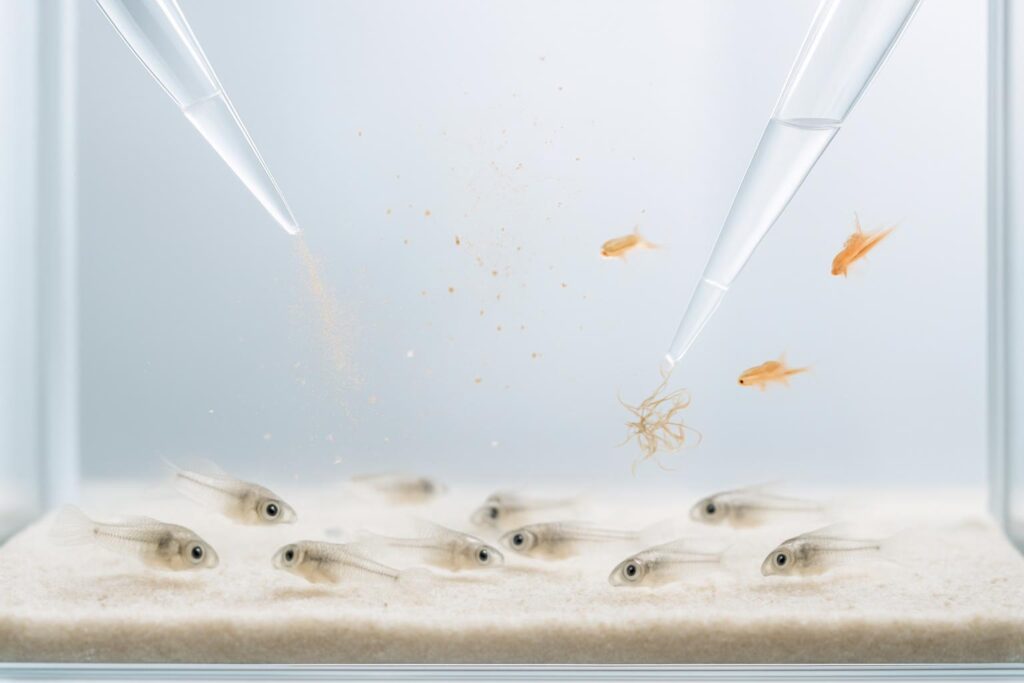
How to feed: Pinch a dusting over the surface or pre-mix a small amount in tank water and target-feed with a pipette near the fry. Feed 3–4 times daily in tiny amounts. Siphon any visible build-up after 15–20 minutes.
Potential downsides: Overuse can cloud water and reduce oxygen. Less feeding stimulation than live prey if used alone.
Tips: Combine with infusoria in the first week for coverage and with live prey from Day 4 onward for faster growth and stronger foraging responses.
3) Baby Brine Shrimp (Freshly Hatched)
Newly hatched artemia are the gold standard growth food. Use quality brine shrimp eggs such as San Francisco Bay Brand and a simple hatchery.
Why it helps: High protein, natural movement, and bright coloration signal fry to feed aggressively. Results in thicker bodies, faster growth, and better survival.
Best for: From Day 3–4 onward, once fry can chase and strike. Use 1–3 times daily for the first month.
How to feed: Hatch daily. Rinse thoroughly with freshwater to remove salt and shells. Offer small portions until bellies turn light orange. Remove uneaten shrimp after 15–20 minutes to protect water quality.
Potential downsides: Requires daily hatching and cleanup. Unhatched shells can irritate fry; careful rinsing is important.
Tips: Keep two small hatcheries running, staggered 12 hours apart, for a constant supply. Store decapsulated eggs in a cool, dry place.
4) Microworms
Easy, slow-sinking live worms that match the bottom-feeding nature of Corydoras fry. Widely offered as starter cultures with simple media.
Why it helps: Their slow wriggle and bottom presence suit cory fry that prefer to graze along surfaces. High acceptance and steady growth.
Best for: Day 5 through Week 4 and beyond, especially in bare-bottom or lightly planted grow-out tanks.
How to feed: Swipe worms from the culture container wall with a cotton swab, rinse in a small cup of tank water, then target-feed near the bottom. Offer 1–2 times daily alongside baby brine shrimp.
Potential downsides: Overfeeding can foul surfaces and cause film on the water. Cultures need refreshing every 1–2 weeks.
Tips: Use thin media layers and ventilated lids. Start a fresh culture weekly for uninterrupted production.
Feeding Schedule for the First Month
Days 0–2
– Infusoria 3–5 times per day in small doses
– Optional: a light dusting of Hikari First Bites once daily
Days 3–7
– Add baby brine shrimp 1–2 times daily after confirming fry chase response
– Continue infusoria twice daily for coverage
– Hikari First Bites once or twice daily in tiny amounts
Week 2
– Baby brine shrimp twice daily as the main growth food
– Microworms once daily for bottom grazing and variety
– Reduce infusoria as fry clearly prefer larger prey
Weeks 3–4
– Baby brine shrimp and microworms 1–2 times daily each
– Begin tiny portions of finely crushed high-protein wafers or a soft gel food during one feeding to prepare for the juvenile diet
Feeding Without Polluting the Water
– Small, frequent meals beat heavy feedings
– Target-feed with a pipette or turkey baster to place food near fry
– Siphon uneaten food and waste after each session using airline tubing
– Change 20–30 percent of water daily with temperature-matched, dechlorinated water
– Use a mature sponge filter with gentle flow and strong aeration
– Keep bare-bottom or very simple substrate for easy cleanup
Common Mistakes to Avoid
– Overfeeding powdered foods until the water clouds
– Skipping first foods and going straight to large prey
– Feeding baby brine shrimp without rinsing out salt and shells
– Keeping a single culture of live food and losing it to a crash
– Sticking to one food and missing the growth boost from variety
Conclusion
Start with infusoria and a light dusting of Hikari First Bites so newborns eat immediately. As soon as they can chase, switch focus to baby brine shrimp and supplement with microworms for bottom coverage. Feed tiny amounts several times per day, keep the tank clean, and increase particle size gradually. This combination yields robust fry with strong appetites and steady, even growth.
FAQ
Q: What is the best first food for newly hatched Corydoras fry?
A: Live infusoria is the safest day-one food thanks to its tiny size, constant motion, and easy digestion.
Q: How often should I feed Corydoras fry?
A: Feed small portions 3–5 times daily, siphoning uneaten food after each session to protect water quality.
Q: When can Corydoras fry start eating baby brine shrimp?
A: Introduce baby brine shrimp around Day 3–4 once fry can chase, then offer 1–3 times daily.
Q: How do I feed powdered foods without clouding the water?
A: Pre-mix a tiny pinch in tank water and target-feed with a pipette, then siphon any buildup after 15–20 minutes.
Q: Do I need live foods, or can I rely on prepared foods only?
A: Prepared foods like Hikari First Bites can work, but adding live baby brine shrimp and microworms drives faster growth and higher survival.