
We are reader supported. When you purchase through links on our site, we may earn an affiliate commission. Also, as an Amazon affiliate, we earn from qualifying purchases.
Reef tanks thrive when nutrients are steady and low. Biopellets give you a controlled, low-maintenance way to reduce nitrate and phosphate by feeding beneficial bacteria and exporting them through your skimmer. If you want cleaner water, better polyp extension, and fewer algae battles in 2026, the right biopellet can help you get there without micromanaging daily dosing.
What biopellets do in a reef tank
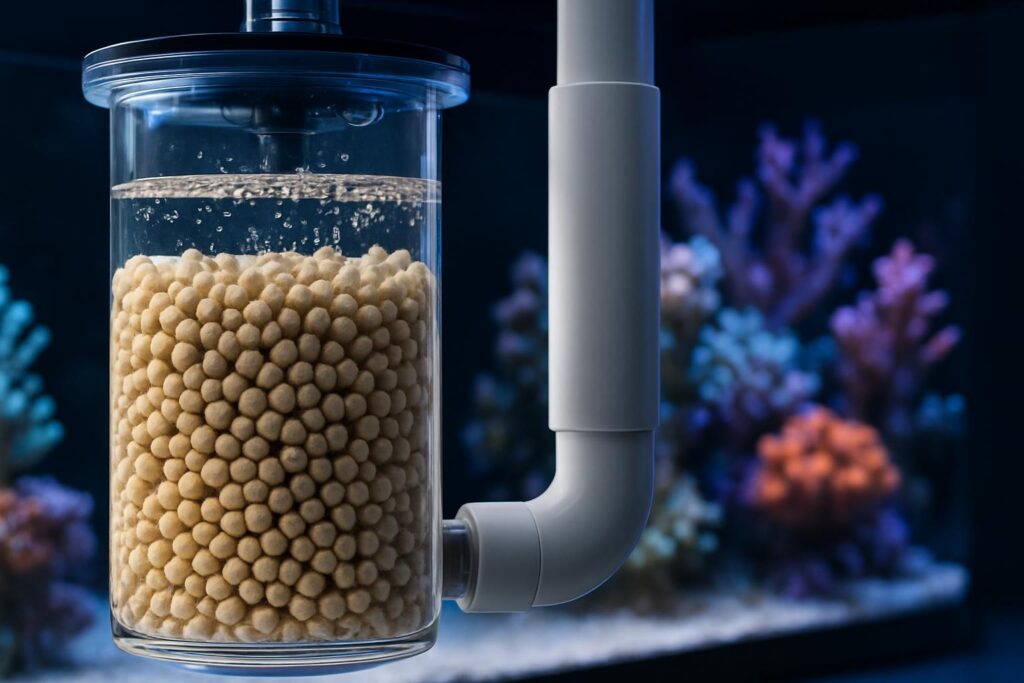
Biopellets are biodegradable polymers that act as a carbon source. Heterotrophic bacteria colonize the pellets, consume nitrate and phosphate, and multiply. When you direct the reactor outlet to your protein skimmer, the skimmer removes this bacterial biomass, exporting the bound nutrients from the system.
Used correctly, biopellets stabilize nutrients, improve water clarity, and support coral coloration. They also reduce the need for liquid carbon dosing and can be more forgiving once tuned.
How to choose reef biopellets in 2026
Pellet shape and density
Uniform, medium-density pellets tumble consistently and resist clumping. A stable tumble keeps biofilm thin and active, which maintains steady export and prevents dead zones in the reactor.
Reactor compatibility and flow
Match pellet size to your reactor plate or screen so media does not escape. Aim for a gentle, even tumble. Too much flow grinds pellets and strips nutrients too fast. Too little flow creates mats and stalls performance.
Nutrient goals and coral types
If your tank runs very high nitrate, pick a responsive pellet and start slow. For mixed reefs or lower nutrients, a steadier, moderate pellet is easier to maintain without bottoming out phosphate.
Ramp-up and maintenance
Look for pellets that start predictably, tolerate partial top-offs, and hold shape for months. This saves time and leads to fewer swings as your biofilter matures.
Setup essentials to avoid problems
Start slow and build up
Begin with 25 to 40 percent of the recommended volume. Let bacteria establish over 2 to 4 weeks, then increase in small steps until you reach your nutrient target.
Seed bacteria and keep oxygen high
Seeding with a trusted bacterial culture shortens the break-in period. Ensure strong aeration and a capable skimmer. Bacteria need oxygen, and the skimmer is your export engine.
Point reactor output to the skimmer
Route the reactor effluent directly to the skimmer intake or into the skimmer chamber. This maximizes removal of bacterial floc and reduces cloudiness.
Watch alkalinity, pH, and feeding
As nutrients drop, corals may consume alkalinity faster. Test alkalinity and pH frequently during the first month and adjust dosing and feeding so you do not starve corals.
Clean and top off
Briefly pause and shake the reactor weekly to loosen mats. Top off pellets when volume shrinks by about one third so performance stays steady.
The 4 best reef tank biopellets for 2026
Two Little Fishies NPX Bioplastics
Two Little Fishies NPX is a proven, balanced biopellet that delivers steady nitrate reduction with controlled phosphate lowering. Pellets are uniform and tumble smoothly in most standard reactors, which makes them beginner-friendly and consistent for long-term use.
Why it helps: Reliable colonization, even tumble, and stable export support mixed reefs that need predictability without nutrient crashes.
Best for: Mixed reefs and reefers who want straightforward, low-drama nutrient control with a good skimmer.
How to run it: Start at 30 percent of the recommended volume. Adjust flow for a gentle simmer rather than a vigorous boil. Route output to the skimmer intake and test nitrate and phosphate weekly during ramp-up.
Real-world performance: NPX typically brings high nitrate down to a manageable range over a few weeks while holding phosphate in check. If phosphate lags behind nitrate, pair with a small amount of iron-based media until equilibrium returns.
Potential downsides: If flow is too low, pellets can clump. If your tank starts with very high phosphate, you may still need supplemental phosphate media during the initial phase.
DrTim’s Aquatics NP-Active Pearls
NP-Active Pearls are formulated for fast bacterial adhesion and strong nutrient uptake, making them a solid pick for heavy bioload systems or tanks coming from persistently high nitrate.
Why it helps: Rapid colonization and high surface area speed up nitrate reduction so you see progress sooner with proper seeding and aeration.
Best for: Heavily fed tanks and SPS systems that need decisive nitrate control while maintaining stable phosphate via careful tuning.
How to run it: Start with 25 to 30 percent of the suggested dose, keep the tumble active, and ensure robust skimming. Test often in the first month and increase only when nutrients trend steadily downward.
Real-world performance: With strong oxygenation and a clean reactor, NP-Active Pearls can pull nitrates down quickly. Many reefers report clearer water and improved polyp extension once nutrients stabilize.
Potential downsides: Overdosing can strip nutrients faster than corals prefer. Ramp slowly, and do not starve the tank. Maintain good gas exchange to prevent bacterial blooms.
Brightwell Aquatics Katalyst Biodegradable Polymer Pellets
Brightwell Katalyst focuses on steady, sustainable nutrient control. The pellets encourage a measured bacterial growth pattern that is forgiving to newer reefers who want gradual results.
Why it helps: Consistent, moderate carbon release supports slow-and-steady nitrate and phosphate reduction that is easy to manage.
Best for: Newer hobbyists, LPS and soft coral systems, and any tank where stability is the priority over speed.
How to run it: Start at roughly one third dose. Set flow to an even, gentle tumble and allow 2 to 4 weeks for bacteria to establish. Top off pellets as they are consumed to maintain volume and performance.
Real-world performance: Katalyst often shines in mixed reefs that are close to their targets but need help keeping nutrients in line week after week.
Potential downsides: Slower to start compared to aggressive pellets. Patience is required, and you should avoid chasing instant results with large additions.
AquaMaxx BioPellets
AquaMaxx BioPellets are high-quality media with consistent size and strong durability, designed to run cleanly in standard pellet reactors with minimal grinding when tuned correctly.
Why it helps: High surface area and durable composition support a dense, active biofilm and long service life with predictable tumble.
Best for: SPS-dominant tanks and advanced users who want firm control of nitrate while fine-tuning phosphate via feeding and export.
How to run it: Rinse lightly before use to remove fines. Start at one third dose, maintain a gentle tumble, and direct effluent to your skimmer. Increase volume only after two stable test cycles.
Real-world performance: When paired with a strong skimmer and adequate flow, AquaMaxx delivers clear, low-nutrient water and stable coral growth. Top off pellets monthly or as volume declines.
Potential downsides: Requires accurate flow control. Excessive turbulence can pulverize pellets, while low flow can mat the media.
Quick comparisons and pairing tips
Best overall balance
Two Little Fishies NPX Bioplastics offer the easiest blend of control and consistency for most mixed reefs.
Fastest response for heavy bioloads
DrTim’s NP-Active Pearls reduce nitrate quickly when paired with a strong skimmer and careful ramp-up.
Most beginner-friendly
Brightwell Katalyst keeps changes gradual and predictable, reducing the risk of bottoming out nutrients.
For SPS-dominant systems
AquaMaxx BioPellets give firm control with clean, durable media that maintains an active biofilm under precise flow.
Smart pairings
If phosphate lingers, add a small amount of iron-based media separately rather than overdosing pellets. Keep feeding consistent, and test alkalinity and nutrients weekly during the first 6 to 8 weeks.
Conclusion
Biopellets remain one of the simplest long-term ways to stabilize nutrients in a reef tank. Pick a pellet that matches your goals, start at a reduced dose, keep the reactor tumbling evenly, and push the outlet to the skimmer. Two Little Fishies NPX is the safest all-rounder, DrTim’s NP-Active Pearls tackle heavy loads fast, Brightwell Katalyst favors gradual control, and AquaMaxx BioPellets reward precise tuning. With patient ramp-up and steady testing, you can run a cleaner, more stable reef in 2026 without daily juggling.
FAQ
Q: What do biopellets do in a reef tank?
A: Biopellets provide a carbon source for bacteria that consume nitrate and phosphate. When reactor output is directed to the skimmer, the skimmer removes this bacterial biomass and exports bound nutrients.
Q: How should I start using biopellets to avoid problems?
A: Start with 25 to 40 percent of the recommended amount, seed bacteria, ensure strong aeration, and set a gentle tumble. Increase slowly after 2 to 4 weeks as nutrients trend downward.
Q: Do I need a protein skimmer when running biopellets?
A: Yes. A capable skimmer is essential because it removes the bacterial floc produced on the pellets and exports the nutrients from the system.
Q: When should I top off or replace biopellets?
A: Top off when pellet volume shrinks by about one third to keep performance steady. Briefly pause and shake the reactor weekly to loosen mats.
Q: Which pellet is best for beginners?
A: Brightwell Katalyst is beginner-friendly because it delivers gradual, predictable nutrient reduction that is easy to manage.