
We are reader supported. When you purchase through links on our site, we may earn an affiliate commission. Also, as an Amazon affiliate, we earn from qualifying purchases.
A 60 litre tank looks modest, but it can host a lively, healthy community when you plan around adult sizes, behavior, filtration, and maintenance. If you only want the number, the safe range for small community fish is usually one main school of 10 to 14 individuals, with the option to add a small bottom group or a single centerpiece fish, provided your filter and care routine support the load. The rest of this guide explains how to choose species that fit, how to avoid common mistakes, and how to keep the tank stable long term.
The short answer for 60 litres
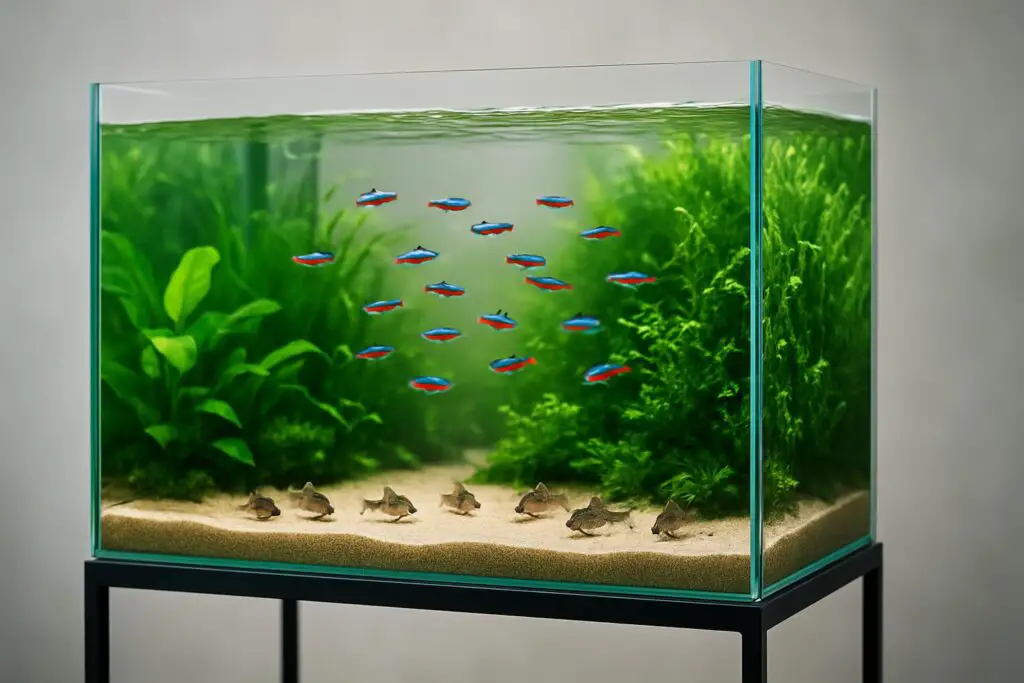
In a 60 litre tank, plan for one main school of 10 to 14 small tetras or rasboras, plus 6 to 8 dwarf corydoras, or a single centerpiece fish instead of the bottom group.
This guideline assumes a mature filter, weekly water changes, and a tank with decent surface area. It also assumes small, peaceful species in the 2 to 4 cm adult range, not large or boisterous fish. If your tank is tall or has minimal surface area, stock a little lighter.
If you prefer a single show fish, a betta or a honey gourami works well in 60 litres, but you should not combine multiple centerpiece fish in this size. For livebearers, manage reproduction or choose males only. Shrimp and snails can be added, but do not use them to offset overstocking with fish.
What really limits your fish count
Tank dimensions and gas exchange
Volume is not the only factor. Surface area drives oxygen exchange. A long, shallow 60 litre tank supports more stable oxygen levels than a tall, narrow tank of the same volume. If your 60 litre is tall or cube shaped, plan a lighter stock list because the top layer can become oxygen limited at night, especially in heavily planted tanks.
Good surface movement from your filter outlet improves oxygenation. Aim for a gentle ripple across the surface, not a still mirror and not a washing machine. This helps your fish breathe and supports a stable biofilter.
Adult size, activity, and territory
Stocking decisions must use adult sizes, not juvenile sizes at the store. A 2 cm juvenile that grows to 6 cm will quickly push the limits. Active swimmers need more room than sedentary species. Schooling fish want a group to feel secure, so plan for a proper shoal number rather than mixing too many different species.
Territorial fish control space rather than just water volume. Even small cichlids can claim half of a 60 litre tank. That is why most dwarf cichlids are better in larger tanks, and if you keep one in 60 litres, it should be a carefully chosen single fish with an appropriate layout.
Bioload, filtration, and turnover
Bioload is the waste your fish and food produce. Your filter and bacteria convert ammonia to nitrite and then nitrate. The bigger the bioload, the more filtration and water changes you need. A mature biofilter is the foundation of stability, and maturity takes time.
Filtration should turn the tank over 5 to 8 times per hour, roughly 300 to 500 L/h for a 60 litre tank. This range supports oxygenation and keeps debris suspended long enough for the filter to trap it. Too little flow can cause dead zones, while too much flow can stress gentle species. Use a sponge prefilter to protect shrimp and fry and to add extra biological surface.
Maintenance commitment
Your weekly routine determines how far you can push stocking. Heavier stocking needs larger and more frequent water changes. Light stocking allows more margin for error. In a new setup, stay conservative while the biofilter matures.
Do 30 to 50 percent water changes every week, and test to keep ammonia and nitrite at zero and nitrates under 20 to 40 mg/L. If nitrates rise faster than expected, either reduce feeding, increase water change volume, or trim the stock list.
Water parameters and temperature
Mix species that prefer similar temperature and water chemistry. Most tropical nano community fish do well around 24 to 26 C. Temperate species like white cloud mountain minnows prefer cooler water and should not be kept with warm water fish in 60 litres.
Hardness and pH tolerance vary by species, but many common community fish adapt well if you keep parameters stable. Stability matters more than chasing a perfect number. Always match new fish to your tank conditions rather than changing the water to suit a single species that does not fit your tap water.
Aquascape and live plants
Plants and hardscape create sightlines, reduce stress, and improve water quality by absorbing nutrients. They also anchor territories and give shy fish places to retreat. While plants help, they do not replace water changes or correct overstocking.
In 60 litres, keep open swimming space in the front or middle and plant denser areas at the back and sides. Provide smooth sand or fine gravel if you plan to keep dwarf corydoras.
A safe way to plan stocking for 60 litres
Step 1 Choose a theme
Decide whether you want a single centerpiece fish, a schooling community, a shrimp focus, or a livebearer display. A clear theme prevents you from mixing too many species with conflicting needs.
Step 2 Choose your main school
For a 60 litre community, pick one midwater school as the focus. Good choices include neon tetra, ember tetra, glowlight tetra, lambchop rasbora, harlequin rasbora, and chili rasbora. Aim for 10 to 14 individuals of one species. A single larger school looks better and behaves more naturally than two small schools.
Step 3 Pick a bottom group
Dwarf corydoras such as pygmaeus, habrosus, or hastatus are ideal for 60 litres. Keep 6 to 8 on soft sand or very smooth gravel. They are social and do best in a real group. Avoid larger corydoras species in this tank size.
Step 4 Centerpiece option
If you prefer a centerpiece fish, choose one. A male honey gourami or a single betta can work. Skip the bottom group if you add a centerpiece to a fully stocked school, or reduce the school size slightly. Do not mix multiple centerpiece fish in 60 litres.
If you keep a betta, avoid fast fin nippers and be ready with a backup plan in case the betta rejects tankmates.
Step 5 Check the numbers against your filter and schedule
Count adults, not juveniles. Confirm your filter turnover, then match your water change plan to the bioload. If you plan for 40 percent weekly water changes and a turnover of about 400 L/h, the recommended counts above are safe for most small species. If you prefer lighter maintenance, reduce the fish count by a few individuals.
Step 6 Add slowly
Add fish in stages over 4 to 6 weeks, not all at once. This lets the biofilter adjust and gives you time to observe new arrivals. Quarantine is ideal if you have a spare tank. If not, add the hardiest species first and watch for any signs of stress or disease.
Example stocking ideas
Peaceful nano community
Choose one midwater school and one bottom group. For example, 12 ember tetras with 7 pygmy corydoras and one nerite snail. Plant the tank, provide gentle flow, and feed lightly. Perform regular water changes as outlined below. This setup is beginner friendly and active without being crowded.
Betta focused tank
A single male betta with a calm environment and many plants can do very well in 60 litres. You can try a light group of peaceful nano fish that do not nip, such as 8 to 10 chili rasboras, plus 6 pygmy corydoras, but be ready to separate if the betta shows aggression. Alternatively, keep the betta with only shrimp and a snail.
If you want a simple plan with minimal risk, keep only the betta as the fish resident and add invertebrates later if the betta tolerates them.
If you keep a single betta as a centerpiece, skip other fin nipping species and keep the betta with only 6 to 10 peaceful nano tankmates or just invertebrates.
Livebearer male only display
Endler livebearers are colorful and active but breed readily. In a 60 litre tank, a group of 6 to 8 males provides color without fry. Add a few shrimp and a nerite snail if desired. Keep plants dense to give the fish cover and to absorb nutrients.
For mixed sexes, population will grow. Have a plan to rehome offspring or to separate sexes after the first generation.
For Endler livebearers, keep 6 to 8 males only to avoid fry, or a trio and be ready to rehome offspring.
Shrimp and snail biotope
For a low maintenance display, focus on invertebrates. A colony of 20 to 30 neocaridina shrimp with one nerite snail fits a 60 litre tank well. Add a heavy plant load, moss, and sponge filtration. Feed sparingly to keep water quality high.
Temperate option
If your room runs cool, white cloud mountain minnows are a great choice. A group of 12 to 14 is lively in 60 litres. Keep them without tropical species and provide good flow and oxygenation. Add a cooler tolerant snail if you want algae control.
Water change and testing routine
Consistency prevents problems. Match your cleaning plan to your stock list and feeding schedule. Rinse filter sponges in tank water, not tap water, to protect bacteria. Vacuum lightly around debris while leaving most of the substrate undisturbed.
Do 30 to 50 percent water changes every week, and test to keep ammonia and nitrite at zero and nitrates under 20 to 40 mg/L. If nitrates hit the upper end quickly, increase change volume, cut feeding, or reduce stocking. Keep a liquid test kit on hand rather than relying on strips alone.
Filtration and flow
A small hang on back, internal power filter, or a large air driven sponge filter can all run a 60 litre tank. Choose media that offers generous surface area and avoid overcleaning. Replace media only when it falls apart, and never all at once.
Filtration should turn the tank over 5 to 8 times per hour, roughly 300 to 500 L/h for a 60 litre tank. Position the outlet to ripple the surface and to spread flow across the length of the tank. If fish struggle in the current, diffuse it with a spray bar or baffle.
Feeding and bioload control
Feed small portions that fish finish in under two minutes, once or twice per day. Skip a day each week to reduce waste. Use quality food that does not disintegrate quickly. Target feed bottom dwellers to ensure they eat without overfeeding the entire tank.
Uneaten food and decaying plant matter raise nutrients and fuel algae. Remove dead leaves, prune plants, and siphon up leftovers after feeding if needed.
Common mistakes to avoid
Mixing multiple midwater schools results in two nervous, undersized groups rather than one confident one. In 60 litres, stick to one main school. Avoid combining fish with conflicting temperatures or temperaments. Research adult sizes to prevent surprises.
Avoid large species like common pleco, goldfish, angelfish, bala sharks, and clown loaches in a 60 litre tank. They outgrow the space, produce heavy waste, and become stressed, which leads to illness.
Do not rely on plants or snails to substitute for water changes. Do not add all fish on day one. Do not chase parameters with constant chemical adjustments. Stability and patience win.
Red flags of overstocking
Persistent nitrate over 40 mg/L despite weekly changes indicates too much bioload or feeding. Fish gasping near the surface, clamped fins, darting, or constant hiding point to stress. An ammonia or nitrite reading above zero at any time is an emergency. Chronic algae blooms or cloudy water after minor feedings also suggest overload or insufficient maintenance.
If you see these signs, act now. Increase aeration, change more water, reduce feeding, clean the filter gently, and reassess the stock list. Removing a few fish can stabilize a tank faster than any additive.
Conclusion
A 60 litre tank is flexible when stocked with purpose. Build around a single school, an optional bottom group, or one calm centerpiece. Match fish to your filtration and to a weekly water change habit. Add slowly, observe closely, and keep numbers modest. Follow these steps and your 60 litre will look full of life without crowding or constant problems.
FAQ
Q: How many small schooling fish can I keep in a 60 litre tank?
A: In a 60 litre tank, plan for one main school of 10 to 14 small tetras or rasboras, plus 6 to 8 dwarf corydoras, or a single centerpiece fish instead of the bottom group.
Q: What filter flow do I need for a 60 litre tank?
A: Filtration should turn the tank over 5 to 8 times per hour, roughly 300 to 500 L/h for a 60 litre tank.
Q: How should I manage water changes and testing?
A: Do 30 to 50 percent water changes every week, and test to keep ammonia and nitrite at zero and nitrates under 20 to 40 mg/L.
Q: Can I keep a betta in a 60 litre community?
A: If you keep a single betta as a centerpiece, skip other fin nipping species and keep the betta with only 6 to 10 peaceful nano tankmates or just invertebrates.
Q: How should I add new fish to a 60 litre tank?
A: Add fish in stages over 4 to 6 weeks, not all at once.