
We are reader supported. When you purchase through links on our site, we may earn an affiliate commission. Also, as an Amazon affiliate, we earn from qualifying purchases.
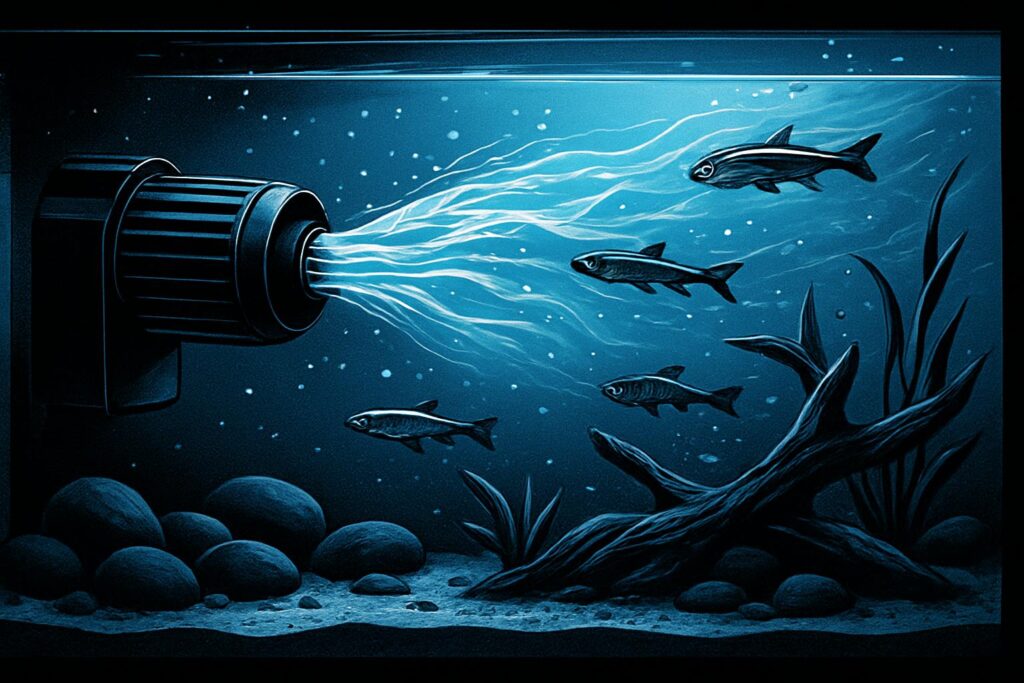
River fish thrive in moving, oxygen-rich water. In still aquariums, they often look dull, breathe faster, and develop health issues. A dedicated water flow pump solves this by creating a steady current that mimics their native streams. This guide shows you how to pick the right pump and reviews four proven models that deliver reliable flow for river fish without stressing your livestock or turning your tank into a sandstorm.
Why River Fish Need Water Flow
Natural behavior and oxygenation
Many danios, hillstream loaches, plecos, rainbowfish, and barbs evolved in habitats with persistent current. Proper flow encourages active swimming, better coloration, and natural feeding behavior. Current also improves gas exchange at the surface, raises dissolved oxygen, and keeps fine waste suspended long enough to be removed by filtration.
Target turnover and what it means
Turnover is the total flow your system moves per hour compared to tank volume. For river fish, aim for 10 to 20 times per hour. A 40-gallon tank, for example, benefits from 400 to 800 gallons per hour of combined flow from filter returns and pumps. Stay toward the lower end if you keep smaller or less energetic species, or if your scape uses fine sand that kicks up easily.
Flow you can sustain long-term
Intensity is only useful if it is stable, quiet, and safe. A good pump provides adjustable flow, a broad pattern that prevents harsh jets, and secure mounting so you can aim current exactly where needed. Your fish should have high-flow lanes and calm eddies to rest. Create both.
How to Choose a Flow Pump
Wavemaker vs. powerhead
Wavemakers use a propeller to move a broad, gentle sheet of water. They are efficient and ideal for replicating natural river flow in most community aquariums. Powerheads produce a narrower jet and work well for driving undergravel filters, river manifolds, or creating a defined high-speed lane. Many aquarists combine both types.
Placement and flow shape
Mount pumps near the surface and aim slightly upward to promote gas exchange and prevent sand storms. Use walls and hardscape to split the flow into parallel lanes. Offset two pumps so their streams meet and create a wide, rolling current across the midwater where fish actually swim.
Safety for fry, shrimp, and long-finned fish
Look for intake guards with fine slots and consider adding a sponge pre-filter for extra protection. Keep flow adjustable. Fish should not be pinned against intakes or glass. If in doubt, reduce speed and reposition.
Noise, heat, and power draw
DC wavemakers run quiet and sip power. AC pumps are simple and robust but can hum if not isolated from glass. Use strong magnets or suction plus magnets to prevent vibration. Keep cables tidy and form a drip loop for safety.
The 4 Best Aquarium Water Flow Pumps for River Fish
1) Hydor Koralia Evolution (multiple sizes)
The Hydor Koralia Evolution is a classic propeller-style wavemaker known for broad, fish-safe flow and reliable magnets. Sizes like 600, 850, and 1150 gallons per hour let you match different tank volumes without overdoing it. The head is compact and easy to aim, and the intake cage spreads suction to protect small fish.
Why it helps: Broad flow mimics river lanes without blasting fish. It reduces dead spots behind rocks and keeps debris suspended for your filter to collect.
Best for: 20 to 75-gallon river tanks where you want a simple, always-on current with minimal setup.
Standout features:
- Wide, gentle stream that covers large areas
- Secure magnetic mount with vibration damping
- Low power consumption for continuous operation
Potential downsides: Flow is not speed-adjustable on the pump itself, so you must choose the right size. The on off cycle from external timers can shorten lifespan; it is better to run it continuously and tune by placement.
Setup tips: Mount 4 to 6 inches below the surface and aim slightly upward to drive surface agitation. Pair a 600 to 850 gph unit with a canister return on a 40 breeder to reach 10 to 15x turnover without sand blowouts.
2) Jebao OW Series Controllable Wavemaker
The Jebao OW series is a DC controllable wavemaker that delivers a wide range of speeds and flow patterns. You can fine-tune output to match sensitive species or ramp it up for strong swimmers. The controller offers constant mode, pulse, and randomized patterns, and multiple speed steps let you dial in the perfect intensity.
Why it helps: Adjustable flow prevents over-stressing smaller fish while still providing the oxygen-rich current river species need. Randomized modes break up detritus pockets and keep your aquascape cleaner.
Best for: 30 to 125-gallon tanks with mixed species, where flexibility and fine control are priorities.
Standout features:
- Multiple modes and speed levels for precise tuning
- Quiet DC motor with low energy use
- Compact head with wide output pattern
Potential downsides: Controllers add complexity. Mount the control box away from splash and keep cables neat. The included intake grill is fairly open; add a sponge guard if you keep fry or shrimp.
Setup tips: Start at a medium speed and observe fish posture and feeding. If fish constantly lean into the current or hug the bottom, reduce output or re-aim the pump to create a calm zone behind wood or rocks.
3) Sicce Voyager Nano 2000
The Sicce Voyager Nano 2000 produces about 530 gallons per hour in a small, durable package. The directional ball joint makes aiming easy, and the magnet keeps it stable on glass. Flow is smooth and even, making it ideal for medium tanks where you want to avoid sharp jets.
Why it helps: The Voyager Nano creates a strong but soft stream that suits hillstream loaches, danios, and rainbowfish. It excels at clearing debris from plant leaves and rockwork without shredding delicate stems.
Best for: 20 to 55-gallon tanks that need a single, efficient wavemaker to reach 10 to 15x turnover when combined with your filter return.
Standout features:
- Compact size with robust magnet mount
- Even, laminar-style sheet of flow with minimal hot spots
- Energy efficient for 24 7 use
Potential downsides: No built-in speed control. Choose the 1000 model for small tanks or the 2000 for mid-sized systems. If you use very fine sand, aim higher to prevent stirring.
Setup tips: Place it on the short side of the tank to push a long river lane across the length. Angle slightly up to promote gas exchange and reduce biofilm on the surface.
4) AquaClear Powerhead 50
The AquaClear Powerhead 50 is a classic powerhead that delivers a tighter jet than wavemakers. It is excellent for driving undergravel plates, sponge prefilters, or a DIY river manifold that pulls water through sponges on one end and sends a strong current down the tank length.
Why it helps: Focused output creates a defined high-speed lane, great for fish that enjoy sprinting bursts. It also draws water consistently through mechanical media, improving clarity and biofiltration.
Best for: 20 to 40-gallon river builds using sponge or undergravel filtration, or for adding a targeted jet alongside a broader wavemaker.
Standout features:
- Reliable, consistent performance
- Easy to connect to sponge intakes or UG filters
- Simple maintenance and durable design
Potential downsides: The jet is narrow. Combine with a wavemaker if you want broad flow across the whole tank. Use an intake sponge to protect small fish and shrimp.
Setup tips: Position near the bottom and point along the tank length to form a strong lane. Pair with a wavemaker high on the opposite wall to return water, creating a stable circular circuit.
Sizing and Matching Flow to Your Tank
Quick sizing guide
- 20-gallon river community: 200 to 400 gph total from filter return plus a 260 to 530 gph wavemaker
- 40 breeder active danios and barbs: 400 to 800 gph total using a 600 to 850 gph wavemaker plus your filter
- 75-gallon rainbowfish or plecos: 750 to 1500 gph total split between two pumps to avoid sand storms
These ranges assume moderate stocking and normal plant density. Heavily planted tanks may tolerate slightly lower flow. Bare-scape or rock-forward layouts benefit from higher flow to minimize detritus buildup under stones.
Single pump vs. two smaller pumps
Two smaller units give better coverage and redundancy. If one fails, the other maintains oxygenation. You can also aim them at slightly different angles to create a rolling current with calm eddies. A single large pump is simpler but may create hot spots and dead zones.
Placement That Works
20-gallon hillstream layout
Place a Sicce Voyager Nano 2000 high on one short wall and angle it slightly upward toward the opposite end. Use cobbles and driftwood to split the flow near mid-tank, making a calm pocket behind the largest stone. This gives loaches a high-flow graze zone and a rest area.
40 breeder danio and barb layout
Mount a Hydor Koralia Evolution 850 on the left side glass and a canister lily pipe or spray bar on the right. Aim both to meet at the midline. This creates a long, even lane across the front where schooling fish display and feed, while the rear corners stay calmer.
75-gallon with plecos and rainbows
Use a Jebao OW wavemaker at mid-height on one end, set to constant medium. Add an AquaClear Powerhead 50 low on the same side to push water through a sponge manifold. The fast bottom lane keeps waste moving toward sponges, while the mid to upper water sees a strong but broader current for active swimmers.
Tuning Flow for Fish Health
Signs flow is right
- Fish swim into the current by choice and rest in calmer spots when needed
- Surface moves continuously and biofilm is minimal
- Food travels in a predictable path and does not vanish into the substrate
Signs flow is too strong
- Fish cling to the bottom or glass and struggle to feed
- Plants bend flat or uproot
- Sand forms dunes and stays airborne
Reduce pump speed, aim upward, or reposition to bounce flow off glass for a softer push.
Maintenance and Reliability
Routine care
- Every 2 to 4 weeks, unplug and remove the pump head
- Soak in a 1 part white vinegar to 3 parts water solution for 20 minutes
- Brush the impeller or propeller and rinse well
- Inspect intake guards and replace if cracked
Regular cleaning restores performance and prevents startup chatter. Keep magnets free of sand to protect glass and prevent vibration.
Troubleshooting
- Rattling or hum: Reseat the pump, ensure the magnet is flat, and add a thin rubber pad if your glass resonates
- Poor flow: Clean calcium deposits from the impeller and intake grill
- Sand storms: Aim higher, reduce speed, or switch to a wider-output wavemaker
Feeding and Flow
Feed small portions and let the current carry food along a route you can watch. Pellets should drift in the midwater, not shoot to the back. Use a feeding ring in the calmer zone to prevent scatter. For bottom feeders, turn flow down briefly if needed, then restore normal speed after feeding.
Putting It All Together
Select a pump that matches your tank size and livestock energy level. Choose broad flow for most community setups and add a narrower jet only if you need a fast lane or to drive a sponge manifold. Place pumps to create steady surface movement, a main current lane, and at least one calm pocket. Keep intakes safe, maintain your gear, and tune flow based on fish behavior. With these steps, your river fish will show stronger colors, better activity, and healthier breathing.
Conclusion
The right water flow pump transforms a still aquarium into a living river. The Hydor Koralia Evolution offers simple, broad flow that just works. The Jebao OW adds precise control for mixed species and changing scapes. The Sicce Voyager Nano 2000 delivers smooth output in a compact body for mid-sized tanks. The AquaClear Powerhead 50 gives you a defined fast lane and powers sponge or undergravel systems. Pick the one that fits your goals, place it thoughtfully, and keep it clean. Your fish will do the rest.
FAQ
Q: How much flow do river fish need in an aquarium?
A: Aim for 10 to 20 times turnover per hour by combining your filter return and one or more pumps.
Q: Should I use one large pump or two smaller pumps?
A: Two smaller pumps improve coverage and create calmer eddies while adding redundancy if one fails.
Q: How do I place pumps to avoid sand storms?
A: Mount them near the surface, aim slightly upward, and use hardscape to split the flow so the bottom stays calmer.
Q: How can I protect shrimp and fry from pump intakes?
A: Use pumps with fine intake guards and add a sponge pre-filter if needed, then tune speed to prevent suction issues.
Q: What signs show my flow is too strong?
A: Fish struggle to swim or feed, plants flatten or uproot, and sand stays airborne or forms dunes.